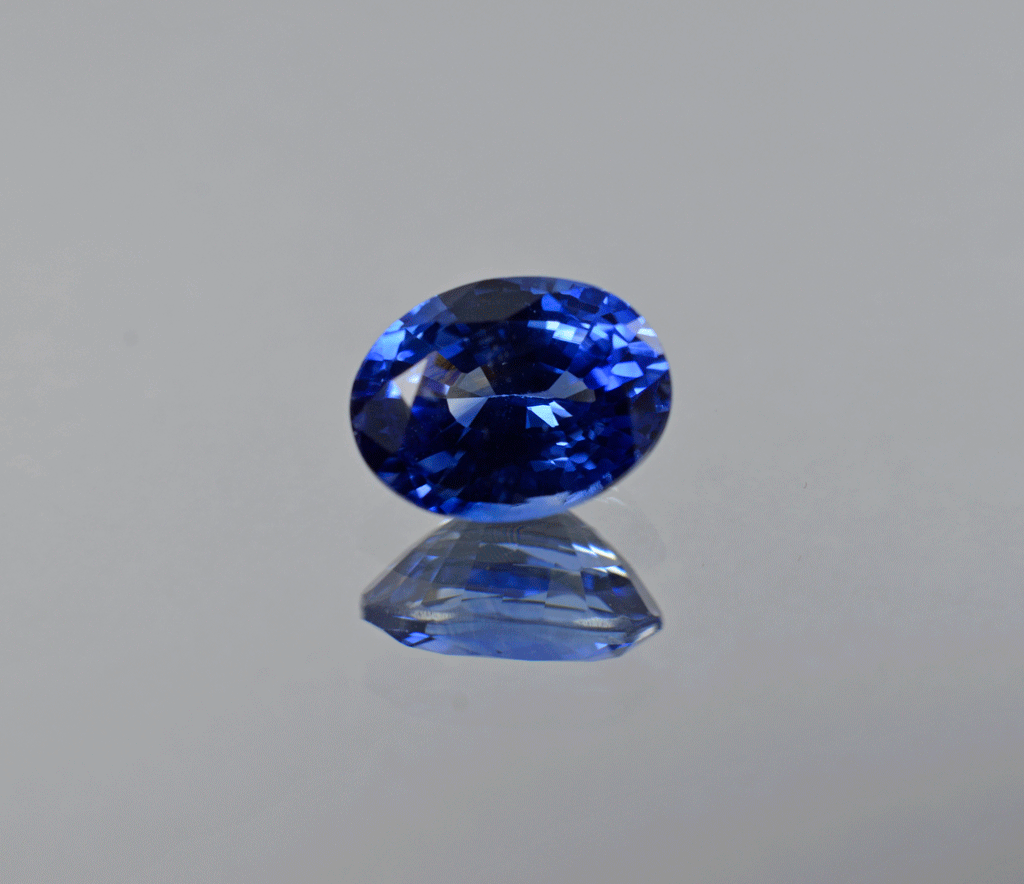
What is sapphire?
Sapphire is a variety of corundum, composed principally of aluminium oxide. Red corundum is called ruby; other colours, including blue, pink, yellow, green and colourless, are called sapphire. A Mohs hardness of 9 gives it good resistance to scratching.
From deep within the earth to river gravels
Gem-quality corundum forms in specific geological environments rich in aluminium and poor in silica, associated with metamorphic rocks or igneous activity. As the host rock weathers, crystals may enter rivers and are often recovered from gravel deposits.
- 01 · Formed beneath the earth
At high temperatures and pressures, corundum crystals form in aluminium-rich rocks or fluids.
- 02 · The host rock weathers
Over time, weathering releases the hard sapphire crystals from their host rock.
- 03 · Concentrated in deposits
Water carries the crystals into gravel beds. Such secondary deposits are worked in Sri Lanka and Madagascar.
How trace elements create blue
Pure corundum is colourless. Interactions between adjacent iron and titanium within its crystal structure absorb certain wavelengths of light, producing blue. Element concentrations, their interactions, growth conditions and colour zoning all influence the colour of each sapphire.
Understanding origin through geology, appearance and rarity
Origin offers an important part of a gemstone’s history, but cannot determine quality on its own. Characteristics from different metamorphic sources can overlap. Laboratories consider inclusions, spectra and trace elements when giving an opinion on origin.
Kashmir
Kashmir
- Geological setting
- Historic workings at high altitude in the Himalayas
- Typical characteristics
- Known for a soft, velvety blue created by light scattering from minute inclusions.
- Rarity
- Historic production was limited. Fine stones from the old workings are particularly rare on the market.
Myanmar
Myanmar / Mogok
- Geological setting
- Mountainous metamorphic zones and secondary deposits in valleys
- Typical characteristics
- Known for fine sapphires with rich yet bright, vivid colour.
- Rarity
- Large, untreated stones of exceptional quality have limited availability.
Sri Lanka
Sri Lanka / Ceylon
- Geological setting
- River gravel deposits, notably around Ratnapura
- Typical characteristics
- A broad range of colour, from bright and transparent to deep blue; larger crystals are also found.
- Rarity
- Despite a long mining history, stones combining fine colour, transparency and size remain uncommon.
Madagascar
Madagascar
- Geological setting
- Ancient metamorphic zones and extensive secondary deposits
- Typical characteristics
- Varied colours and inclusion characteristics; some stones resemble those from classic sources.
- Rarity
- An important modern source with considerable variation. Origin alone is insufficient to judge a stone.
Thailand, Cambodia and Australia
Thailand, Cambodia and Australia
- Geological setting
- Deposits associated with basaltic volcanic activity
- Typical characteristics
- Iron often plays a prominent role; deep blue, blue-green and darker tones are common.
- Rarity
- Bright, fine stones outside the typical pattern also occur. Each gemstone must be assessed individually.
Montana
Montana, United States
- Geological setting
- Small deposits in mountainous areas and rivers
- Typical characteristics
- Known for distinctive, understated grey-blue, blue-green and teal hues.
- Rarity
- Production is limited; untreated stones with harmonious colour have a particular appeal.
Royal blue and cornflower blue
Royal blue generally describes a deep, vivid blue; cornflower blue suggests a somewhat lighter, softer blue. These are not simple, globally uniform grades that can be determined from one photograph. Hue, tone, saturation, zoning and light return should all be considered.
Assess heat treatment and origin separately
Heat treatment is widely used to improve the appearance of sapphire colour and clarity. Treatment is one part of overall quality; unheated status alone does not guarantee beauty. For valuable stones, use a reliable laboratory report to confirm natural origin, treatment status and any opinion on geographic origin.
View the actual gemstone under different lighting
View the stone in daylight, warm light and indoor lighting. Consider whether the blue becomes too dark, whether zoning is evident and whether light returns evenly through the face. Origin and colour names provide context; the appeal lies in the balance of colour, transparency, cut, size and treatment status.