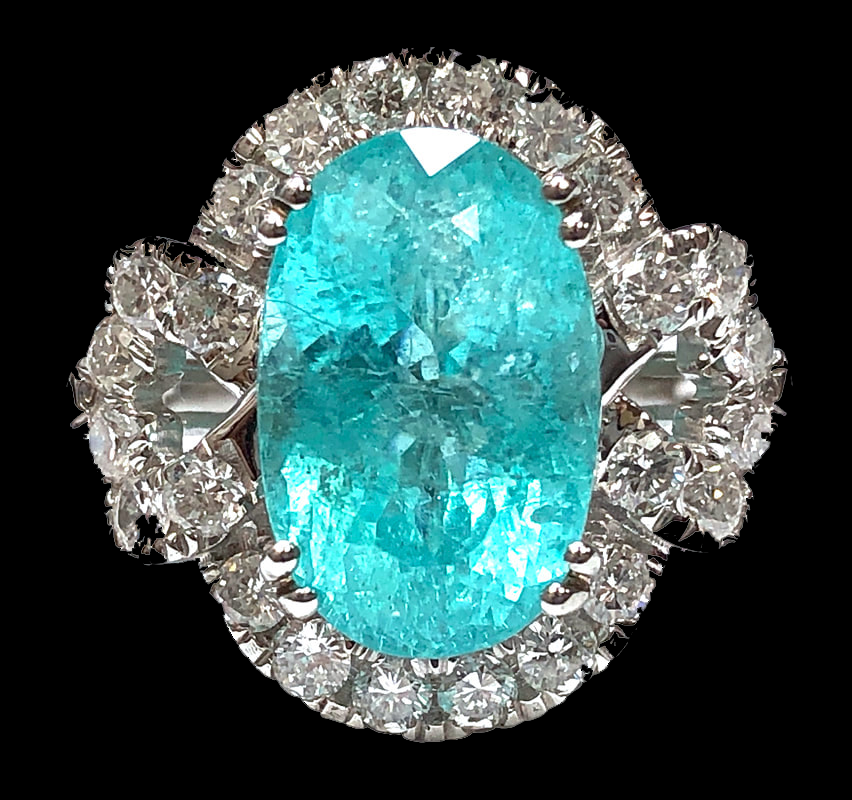
Paraíba is copper-bearing tourmaline
Paraíba is not a separate mineral species. The name describes elbaite tourmaline coloured principally by copper. It is known for saturated blue, green and blue-green; trace manganese also influences its colour.
Copper and manganese influence light absorption and colour
Copper ions are associated with vivid blue to green, while the state of manganese may contribute purple or pink. Heating may reduce manganese-related absorption, diminishing purple and producing blue or green.
- Pegmatite
Tourmaline crystals grow slowly in fluids within granitic pegmatites.
- Copper and manganese
Copper and manganese within the crystal together create its distinctive colour range.
- Weathering
Weathering can release gems into secondary deposits. Such deposits are worked in both Brazil and Mozambique.
Three major sources: discovery and supply
Copper-bearing tourmaline was found in Nigeria and Mozambique after its initial discovery in Brazil. Some stones share similar appearances and routine test properties; geographic-origin identification requires quantitative trace-element analysis.
Brazil · Paraíba State
Brazil / Paraíba State
- Geological setting
- Small pegmatite deposits around São José da Batalha
- Typical characteristics
- Known for vivid, highly saturated blue to green, often in smaller stones.
- Rarity
- Supply from the early workings and larger crystals are limited. Fine examples with documented origin are particularly uncommon.
Brazil · Rio Grande do Norte
Brazil / Rio Grande do Norte
- Geological setting
- Multiple pegmatite workings in northeastern Brazil
- Typical characteristics
- Produces blue and green copper-bearing tourmaline, with substantial quality variation, as in Paraíba State.
- Rarity
- Beyond the country of origin, confirm the individual stone’s colour, transparency, size and laboratory findings.
Nigeria
Nigeria
- Geological setting
- West African pegmatite regions
- Typical characteristics
- Some stones show highly saturated blue to green and resemble Brazilian material.
- Rarity
- Supply is limited. Appearance alone may not distinguish it from Brazilian material.
Mozambique
Mozambique
- Geological setting
- Pegmatite and alluvial deposits in the Alto Ligonha region
- Typical characteristics
- A broad range of colours and sizes, including larger transparent stones.
- Rarity
- An important modern source, though fine neon-coloured material represents only part of its production.
Neon is a visual impression, not light emitted by the stone
The gemstone does not emit its own light. Saturated colour, a bright tone, limited dark areas and copper-related absorption combine to create an internally luminous impression. Beyond photographs, observe whether it retains colour in diffused light.
Assess inclusions for both appearance and durability
Growth tubes, fluid inclusions and healed fractures may be present. Some inclusions are acceptable in a stone with exceptional colour, but surface-reaching fractures, chips and extensive filling can affect durability and require separate assessment.
Confirm origin and heating separately
Heating may be used to adjust colour and should be disclosed even when the result is stable. Origin and treatment are separate findings; Brazil or Unheated alone cannot establish fine colour or transparency.
Consider colour, brightness, size and laboratory documentation
Beyond the colour name, compare saturation, dark areas, zoning, transparency, cut and weight. For valuable stones, confirm copper-bearing characteristics, treatment, origin opinion and the match between the report and the actual stone. Do not rely on a market name alone.