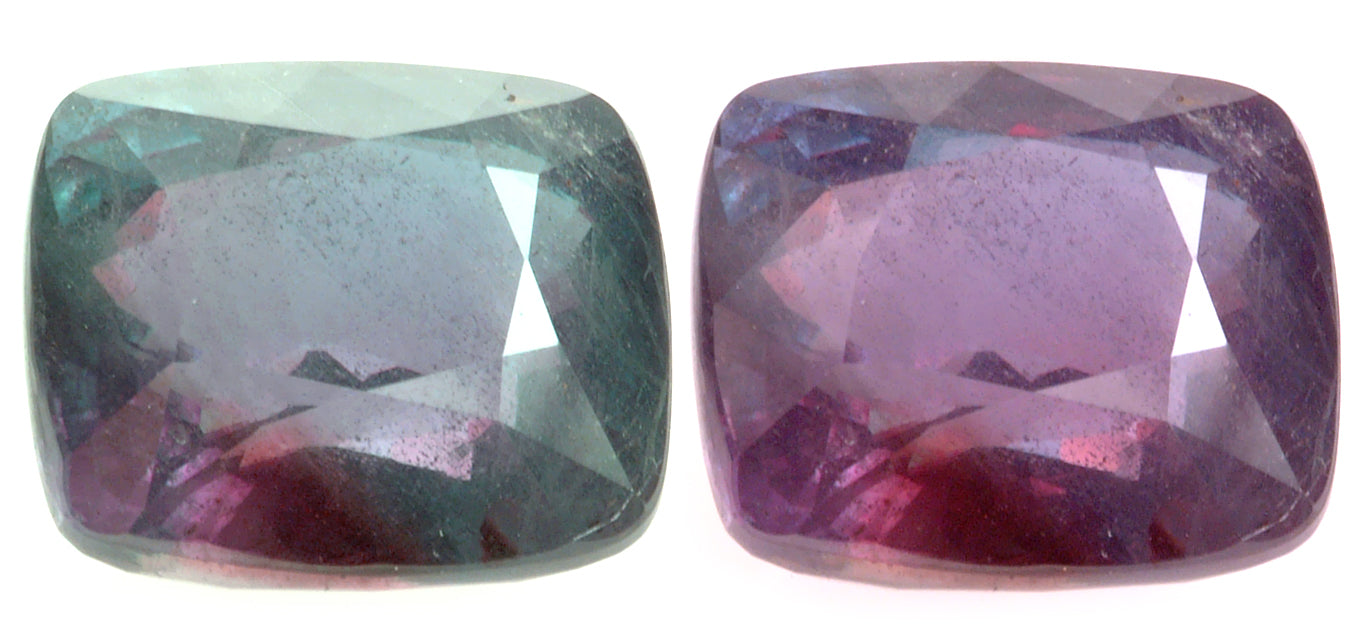
Alexandrite: colour-changing chrysoberyl
Alexandrite is the colour-changing variety of chrysoberyl. With a Mohs hardness of 8.5, it is suitable for jewellery. Natural stones that combine a distinct change, attractive colours in both lights, transparency and substantial size are limited.
Chromium and the spectrum of the light source create two appearances
When chromium replaces some aluminium in the crystal, it absorbs particular wavelengths. Daylight contains more blue-green light, while incandescent lamps or candlelight contain more red light. The dominant colour reaching the eye therefore changes in the same gemstone.
- Chrysoberyl
A crystal containing beryllium and aluminium, formed under limited geological conditions.
- Chromium
Trace chromium in the crystal creates distinctive absorption between green and red.
- Light source
Different wavelength distributions make the gemstone appear different in daylight and warm light.
The history and colour ranges of different origins
After the historic discovery in Russia, production was also identified in Brazil, Sri Lanka, East Africa and India. GIA studies the identification of major origins using inclusions, trace elements and spectral data.
Russia
Russia / Ural Mountains
- Geological setting
- Historic metamorphic and metasomatic deposits associated with emerald occurrences
- Typical characteristics
- Fine examples with a distinct change from green in daylight to red in warm light are often used as a reference.
- Rarity
- Fine nineteenth-century material is exceptionally limited; stones with both quality and provenance are particularly rare.
Brazil
Brazil / Minas Gerais
- Geological setting
- Deposits associated with pegmatite regions
- Typical characteristics
- Became an important source in the 1980s, producing fine stones with a distinct colour change.
- Rarity
- Output fluctuates; large, transparent examples with a strong colour change remain limited.
Sri Lanka
Sri Lanka
- Geological setting
- River gravel deposits with a long mining history
- Typical characteristics
- Larger transparent stones occur, with varied colours in daylight and warm light, including yellow-green to brownish red.
- Rarity
- Beyond size, assess the appeal of both colours and the clarity of the change in each stone.
Tanzania and East Africa
Tanzania and East Africa
- Geological setting
- Deposits associated with metamorphic zones and pegmatites
- Typical characteristics
- May change from blue-green to purplish red, with saturation and transparency varying between stones.
- Rarity
- Fine stones are scarce from every source. Laboratory identification and in-person comparison remain important.
India
India
- Geological setting
- Metamorphic areas and secondary deposits, including southeastern regions
- Typical characteristics
- Known for changes such as green to brownish red, with varying degrees of colour change.
- Rarity
- The combination of colour-change extent, both colours and transparency matters more than the origin name alone.
Consider the extent of colour change as well as the two colours
If one colour is attractive and the other weak, the overall colour change remains limited. Consider how much of the face changes clearly, whether transitional colours are muddy, and how distinct the green and red are. Camera processing affects photographs and video; use them as references.
A cut should reveal attractive colour under both light sources
Crystal orientation and cutting angles influence colour and brightness. Under both light sources, inspect dark centres, windowing and balance. Compare face-up dimensions too, to see whether the stone was cut excessively deep to retain weight.
Colour change alone cannot identify natural alexandrite
The market also includes synthetic alexandrite, colour-change sapphire, colour-change garnet and colour-change glass. A natural-looking change does not establish that a stone is natural alexandrite. Inclusions, spectra and growth structures require professional examination.
Compare both light sources under consistent viewing conditions
With comparable light types and intensities, maintain the gemstone’s orientation and viewing distance when comparing the two appearances. Assess hue, saturation, tone, extent of change, transparency, cut, size and natural-versus-synthetic identification together.